deviceWISE® Intelligence Suite: Enabling Active Intelligence
By John Keever
Linir Zamir
Kent Hahn
February 26, 2026
By John Keever
Linir Zamir
Kent Hahn
February 26, 2026
Estimated reading time: 9 minutes
Factories have progressed from traditional automation to Industry 4.0 practices based on connected data and adaptive processes. Each stage of advancement has expanded manufacturing capabilities. For years, manufacturers have digitized their operations to enable real-time data analysis. As factories evolved, their data systems became more complex, creating new challenges.
Data is often scattered across multiple locations. This fragmentation creates blind spots. Operators may not see critical anomalies until it’s too late. Engineers waste time searching for context instead of solving problems. Meanwhile, factories face pressure to increase productivity and do more with less.
Now, artificial intelligence (AI) agents are the next step in automation as factories transition to Industry 5.0. The deviceWISE Intelligence Suite focuses on assistive intelligence. It transforms raw data into active intelligence. This data-driven approach leverages the information flowing through the factory to power industrial AI agents that:
AI agents provide actions exactly where and when needed, with a clear record of observations and reasons behind each response. These systems help predict and guide issues, enabling people to concentrate on higher-value decisions. Operators shift from merely reacting to alarms to supervising closed-loop systems. Intelligent collaboration enhances human expertise.
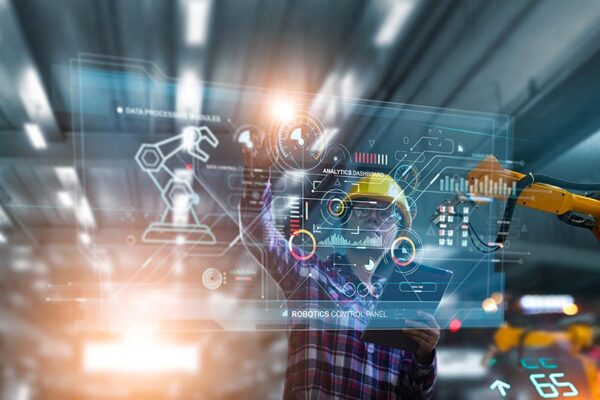
An industrial AI agent is a digital expert embedded in your systems. It’s a specialized AI assistant that interprets and acts on industrial data to support smarter, faster decisions. AI agents learn from data and respond to changes to help maintain continuous performance on the factory floor.
Rather than remaining fixed, each agent evolves over time. As customer needs grow, new agents can be developed.
Every agent adds a layer of cognitive capability across systems in real time by:
Together, they extend intelligence throughout the factory.
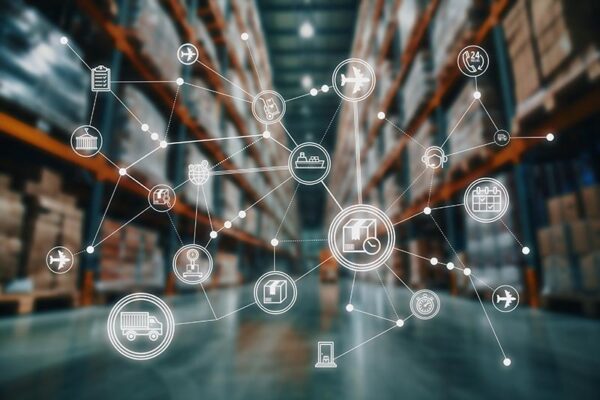
Traditional connectivity moves data by collecting and transferring information between machines and systems. Active intelligence goes further. It trains industrial AI agents to:
Active intelligence acts in real time and uses insight to understand and improve:
Bringing intelligence to the edge allows factories to reduce lag time between detection and response. Quality assurance also evolves.
AI-driven agents learn from each interaction and help maintain consistency across production lines. Intelligence improves when agents can simultaneously:
On a robot cell, a camera might detect an alignment issue while time-series data reveals a vibration spike. Combined, these signals identify the root cause, and the agent can automatically recommend or initiate a fix.
Operators maintain full visibility throughout the process. Each agent provides transparent reasoning for every action, building trust through clarity. Unplanned downtime is reduced, and inspection accuracy is improved across visual inspection AI programs.
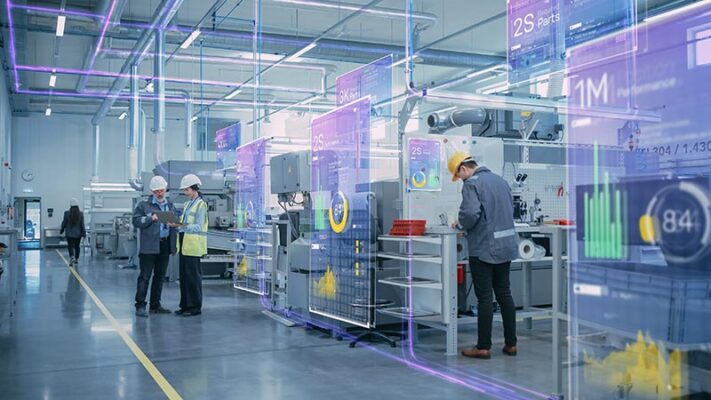
Edge hardware and GPUs have advanced to run intelligence directly on the factory floor. It’s secure and economical, without cloud dependence. With AI now accessible to everyone, industrial intelligence is viable at the edge.
For over a decade, deviceWISE has connected industrial Internet of Things (IIoT) technologies. The platform collects real-time data from manufacturing devices, like programmable logic controllers (PLCs) and robots. The addition of orchestration allowed engineers to model logic with version control and maintain a complete change history.
deviceWISE developers went beyond simple connectivity to build a platform that understands and responds to data. From there, it was a natural step to add AI to analyze the large data streams deviceWISE already manages.
This foundation enabled the integration of intelligence into production without disrupting controls. Governance and safety were in place before AI arrived.
Unlike many AI tools that rely on the cloud or frequent retraining, deviceWISE enables intelligence at the edge and throughout the manufacturing ecosystem. This approach reduces latency and keeps change management in familiar hands.
Using the Model Context Protocol (MCP), deviceWISE Intelligence Suite shares factory context with external AI systems. It then receives actionable insights in return. The suite can act as either a server providing context or a client consuming it.
By supporting both roles, the system simplifies collaboration. It also lays the groundwork for agentic AI to operate across the broader industrial ecosystem.
MCP bridges the gap between raw factory data and intelligent decision-making. This enables deviceWISE to support agent-based intelligence.
With that bridge in place, the deviceWISE Intelligence Suite can deploy purpose-built industrial AI agents at the edge, where work occurs. It automatically and intelligently shapes edge performance. deviceWISE is trusted, assistive intelligence in action, not a black box.
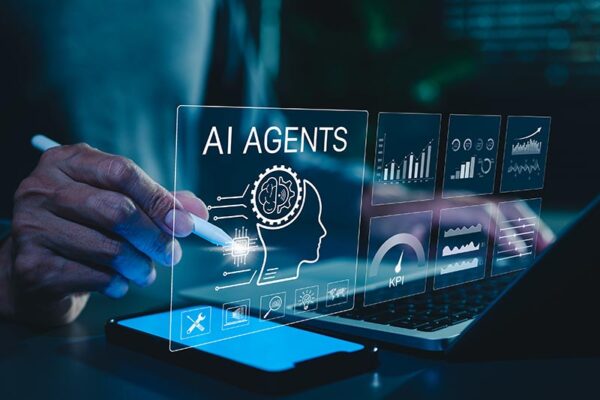
AI-enhanced deviceWISE learns from live data. The system supports faster, more informed decision-making from the factory floor to enterprise management. Operators can anticipate issues before they escalate.
The deviceWISE Intelligence Suite contains several core categories of industrial AI agents. Each agent is tailored for a specific role:
Together, they create a shared foundation for autonomous action where agents learn from context and respond directly at the edge.
Agents in this category guide technicians through procedures and verify that tasks are completed correctly. An agent can walk an operator through an assembly sequence. It confirms procedures are followed and steps are properly performed.
These agents analyze live and historical machine data to uncover inefficiencies and bottlenecks. They form the foundation for predictive maintenance and continuous optimization within the suite.
Acting as a natural-language interface, these agents provide users with instant access to technical documentation. Once manuals or training materials are uploaded, the agents retrieve fault information or device details in seconds.
These agents distill complex information into clear, actionable summaries. They might summarize an inspection video or an error report. They’re multimodal and understand different types of content.
With QA agents, engineers can ask context-aware questions. The answers are precise and data-backed, helping to bridge the gap between oversight and automation. These agents ensure quality in operations and the finished product.
The first two categories — process insights and summarization — are available now. The remaining categories are on the roadmap. These initial agents deliver:
With deviceWISE Assistant, the factory becomes a living network. Agents learn how machines operate and how processes interact, spotting issues before they escalate. Without manual setup, they interpret context across:
The result is a self-mapping factory floor where every signal carries meaning with memory and intent.
Anomalies are not just flagged; they are explained. Using generative modeling and semantic reasoning, agents detect irregular behavior without prior examples.
Factory intelligence now goes beyond alarms. It expands into actionable knowledge, providing the intelligence to correct issues or guide someone in fixing them.
Traditional factory infrastructure collects data and reports issues. deviceWISE Assistant redefines that model by embedding intelligence directly into the data flow with:
These advancements mark a turning point for manufacturers. They can react to data and reason with it as it happens, accelerating manufacturing productivity and resilience.

Agents first coordinate and share context. Then, they combine multiple signal types to explain why something is happening, not merely that it occurred.
This integrated, multimodal reasoning extends edge AI solutions beyond basic connectivity. It creates a foundation for closed-loop intelligence that adapts to changing conditions.
The deviceWISE Intelligence Suite enables seamless orchestration and collaboration through NVIDIA NIM™ (NVIDIA Inference Microservices) and the MCP. NVIDIA NIM is a set of prebuilt software microservices packaged in containers. It provides a faster, simpler way to deploy modern AI models on any NVIDIA‑accelerated infrastructure. They transform deviceWISE into a collaborative force within the broader AI ecosystem.
NVIDIA NIMs accelerate agent development and decision-making. They enable each agent to utilize the most effective model for a specific task.
Meanwhile, deviceWISE supports MCP in both directions. It can function as an MCP server, providing a comprehensive factory context to connected applications. It can also serve as an MCP client, consuming insights from other MCP-enabled AI systems.
NIMs help connect agents more quickly; MCP makes them excellent teammates with the rest of your AI stack. Together, they position deviceWISE as an orchestrator and collaborator.
Traditional factory systems collect data and report issues. deviceWISE Intelligence Suite transforms operations with intelligent assistants that see, think and act across every machine and sensor. The result is faster decisions that:
The suite arrives fully integrated, eliminating the need to manually connect or configure separate tools. It signifies a clear shift from passive connectivity to active intelligence, where agents convert plant data into prompt action.
Collaborations with leading AI model developers and hardware vendors extend Telit Cinterion’s reach to the industrial edge. By adhering to open standards, we ensure scalable interoperability and continuous evolution without vendor lock-in.
Ready to unlock the full potential of industrial AI? Connect with a Telit Cinterion expert to explore how intelligent agents can power your next-generation factory.