Q&A: How AI Updates Telit Cinterion’s IoT Product Development
July 23, 2026
Estimated reading time: 6 minutes
Internet of Things (IoT) product development is entering a new stage as artificial intelligence (AI) becomes part of daily engineering tasks. More teams are integrating AI into their processes, using it as a practical tool rather than experimental technology.
Antonino Sgroi, Telit Cinterion’s global head of R&D, discusses how his teams incorporate AI across the IoT product development process and why the implementation sequence matters.
Telit Cinterion’s R&D process supports the entire product lifecycle. Quality discipline is an integral part of how that system operates and is built into each development phase.
We follow rigorous development standards across our global operations. Validation testing is a crucial step, not just a formality. We conduct design reviews with technical support and R&D engineers and perform application-level precertification testing.
Go Behind the Scenes
See how Telit Cinterion’s R&D team takes an IoT product from concept to certified hardware. Read Inside Telit Cinterion’s IoT R&D Process
New ideas tend to arrive with noise and skepticism. They create uncertainty, but also enthusiasm and attention. Over time, they become the foundation of how teams build and deliver technology. What starts as disruption becomes a normal part of the toolbox.
AI is not just an engineering tool. It must support the entire system, or it simply shifts the bottleneck elsewhere. Today, it is over-discussed, almost mythologized. But before long, I expect it to become a silent and powerful companion in our work, like other waves of innovation I have seen over the last 20 years.
My motivation to introduce AI into our development cycle was practical. Our engineers are exceptional, but too much of their time is spent on repetitive, low-value work. AI lets us remove that friction so they can focus on the architecture and innovation that matter most to our customers.
AI is powerful and streamlines processes when used correctly. We use it to eliminate friction, allowing teams to focus on the architecture and innovation that matter most. With AI, we create more space for innovation that provides value to customers.
We followed a precise sequence because with AI, where you start is as important as how you start.
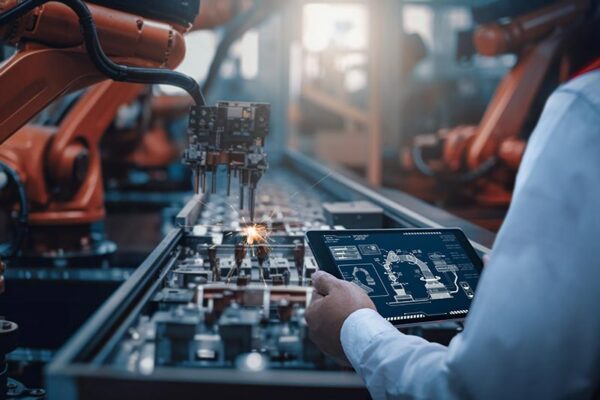
We began here on purpose because accelerating development without strengthening validation just moves the bottleneck downstream. We used AI to speed up log analysis and root-cause detection, so validation could keep pace once everything else got faster.
That foundation was important because the rest of the cycle was about to accelerate. It positioned validation to scale with that speed instead of becoming the next bottleneck.
Only once validation was ready did we expand AI into software development, where it now generates repetitive code and speeds up reviews without lowering our quality bar. We also use it for guided debugging and to draft documentation where appropriate.
This is also where a broader strategy comes in. We invest in customized software and embedded algorithms that make development easier for our customers, so they can move from concept to product more efficiently.
This improves throughput without compromising quality because validation has already been reinforced.
From there, we brought AI into customer support, which is often the first to spot patterns in the field. AI helps us interpret logs faster and surface recurring issues, so support engineers reach recommendations sooner. Those insights feed back into engineering.
Strengthening support strengthened the whole pipeline. If we had accelerated coding first, everything else would have collapsed.
We are still searching for the right AI solutions for hardware. AI could help significantly with PCB layout and RF tuning, and eventually with digital twin simulation that tests assumptions before we commit to a build. That can improve early feasibility decisions and reduce avoidable rework.
The tools are not yet mature enough for our industrial standards, and we will not lower that bar. Still, I am convinced the breakthrough is coming, and when it does, we will integrate it quickly.
The 2026 hackathon was our cultural accelerator. The idea came from engineers across different regions, which makes it a strong example of bottom-up innovation.
Engineers needed protected time to experiment with AI freely, with no pressure and no deadlines.
The goal was not about finding the single “best idea.” I hoped to spark curiosity and build the confidence to experiment and to get people to exchange ideas across regions. After the event, people stopped asking why AI and started asking where else we can apply it. We are already planning another for 2027.
Two things stand out: execution speed, because teams solve problems faster and deliver sooner, and a mindset shift. Engineers now naturally ask whether AI can help them do something smarter. That shift is worth more than any single tool.

Several directions, and they all point the same way. Development and intelligence are moving closer together.
We are watching multi-agent workflows and AI-assisted hardware design most closely, with testing pipelines and edge intelligence growing more adaptive over time. They can change how teams organize complex work: instead of one engineer driving a task end to end, AI agents can help break work into smaller steps. Those steps move forward in parallel with human oversight.
We are also tracking AI-assisted RF and hardware design, even if the tools still need time to mature for industrial use. On the software side, we expect testing pipelines to become more adaptive as AI improves signal detection.
Over time, we also see deeper edge intelligence emerging as more products require local decision-making, not just connectivity. The boundary between development and intelligence is shrinking quickly.
Start small but make the wins visible. Momentum matters, especially when teams are skeptical.
Make sure teams understand how to use AI in IoT product development, or it becomes noise instead of leverage. Build governance and internal champions early, and stay adaptable, because AI evolves constantly. Above all, AI does not replace engineers; it amplifies engineers.
We are actively exploring what it means to embed AI in our products. We will share more when we are ready.